Showing posts with label homeschool. Show all posts

Saturday, August 8, 2015

How To Plan A Flexible Homeschool Schedule

Someone asked me recently if we use a schedule in our homeschool, and I thought this would be a good time to write about how to put together your own homeschool schedule.  The answer is yes, we do use a schedule, but it's very flexible.  In our first year of homeschool I had decided we were going to be just like the public and private schools.  Lunch would be at a certain time.  Math at a certain time.  Play time at a certain time.  That lasted for about a week before I realized that for our family it just wasn't going to work and wasn't necessary.

I try my hardest to plan school on days my husband works, and less school on days that we have to do things like go into the homeschool center for PE, or attend homeschool art classes.  Even with that planning sometimes we get overwhelmed and the schedule gets thrown out the window for the day.  Flexibility on my part is the key to my sanity though, and my daughter's happiness.  For this reason I plan a flexible schedule.

Freebie Friday - Book Report Worksheet


My 2nd grader is going to be doing book reports for the first time on the novels she reads this year.  For us a book report is a process.  She'll read the book, fill out this handy worksheet I'm sharing with you, illustrate and color a book cover on a plain no-line index card and then put the card up on our reading board, then decorate half a poster board (where she'll tape or glue her book report form to).  Finally she'll verbally tell us about the book she read and all of the artwork she made.  I looked online and there were a lot of cute book report worksheets out there, but none that I really fell in love with, so last night I made one and decided to share.  I know I posted this on Saturday, but I made it on a Friday so it still counts for our Freebie Friday ;)


Friday, May 29, 2015

Freebie Friday - Bubble Math: Learn To Add Fast


Being able to add quickly in your head is an essential skill not only for more advanced math but also in daily life.  Think about going shopping and being able to add prices in your head quickly to make sure you don't go over budget.  Or think about adding measurements together quickly when you're building something.  Bubble math is an easy way to gain the skill of adding quickly.  You can download the Bubble math packet as a PDF (numbers 1-12) HERE for free and print it off.  If you want to share this resource, please share the link to this blog post.

Inside the bubble math packet are instructions and tips for the teacher on how to do the exercises.  When using these bubbles for addition practice, the student is trying to get to the number in the left bubble.  In the example to the left the number the student is trying to get to is 10.  They are given the number 4 in the top right bubble, and need to fill in the blank bubble with a number that when added to 4 equals 10.  In our example the student fills in the number 6, because 6+4=10.  The student asks himself, 4 plus what number equals 10?

You can also use this packet for subtraction practice by reversing the above process.  For subtraction practice the student would ask himself: 10 minus what number equals 4 and fill in the blank.

Thursday, May 21, 2015

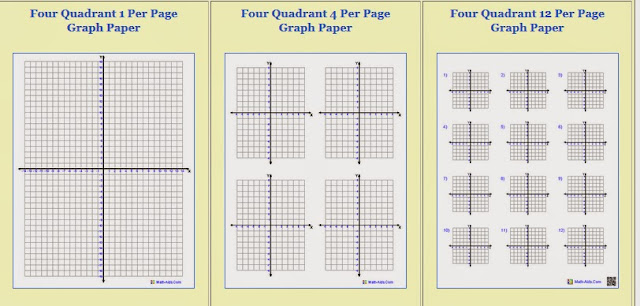
Homeschool Math - Free Printable Graph Paper


Need graph paper to demonstrate a concept?  Or maybe your kids need graph paper for schoolwork.  Math-Aids has really nice free, printable PDF graph paper of all kinds, and the cool thing is that you can customize the size of the grids before printing.  You can see some of the kinds of graph paper they offer below.  They also have other math worksheets, but I'm most excited about the graph paper, which we've already used a number of times.  I know we'll be back time and again to print more, and I really wanted to share this free resource with you.

http://www.math-aids.com/Graph_Paper/

I hope you find this resource useful.  If you know of other free math or homeschool resources, let us know in a comment below so we can share them with everyone.


At home education resources for homeschoolers.

Wednesday, April 29, 2015

Freebie Friday - Fun Addition and Multiplication Drills


Who says math has to be boring?  Today I have another freebie for you.  This time it's addition and multiplication drills.  You can print the PDF HERE.  


The idea is simple, print the page you want to practice, write the operation being practiced in the square box in the center (addition or multiplication), and then have the child perform the operation on the number in the center of the flower with one of it's petals and write the answer in the outer petal.

In the PDF there is a title page, an instructional page with examples and tips and tricks to make this exercise fun and interesting, and four pages of flower drills.  In the center of the flowers the numbers go from 1-12 and there are two flowers per number.  For each center number (1-12) there are the numbers 0-13 to practice with in the petals, with special emphasis on the numbers 7 and 9 which students often have trouble with.

Wednesday, April 22, 2015

10 Kid Friendly Activities For Earth Day


When is Earth Day?  It falls on April 22nd every year.  This can be a fun time to teach your kids about being environmentally friendly, recycling, pollution, conserving water, or growing your own food or other plants.  Here are 10 easy activities to do with kids on Earth Day.

1) Do A Nature Scavenger Hunt

This can be done in any nearby park, wooded area, or even your yard.  Write out or print a list of 10-30 things in nature for your kids to find.  Give them a clipboard with the list and a pen and send them off on their hunt.  Another variation of this would be to give them a camera and tell them to take pictures of everything on the list, or ask them to collect samples of 5 things on the list, so long as those samples aren't doing any damage to nature. 

What can you put on this scavenger hunt list?  Here are a few ideas: A feather, an animal, a bug, a spider, an ant, a bird's nest, a tree with tree sap, a large pinecone (or other type of cone), a small cone, a budding flower, a flower in full bloom, animal tracks, compacted soil, non-compacted soil, a leaf, mushrooms, a butterfly, a trail of ants, dew (if it's a hunt in the morning), a grass hopper or praying mantis, a fern, an area where humans have changed nature, an area where nature has probably been the same for 20 or more years (a wild or overgrown area would also work), wild animal scat (poop). 

Modify this list to your local area.  Are you doing this hunt on the beach?  Add some beach items to your list.  Are you doing this in a desert region?  Add  things from that region to your list.


2) Do A Litter Walk

Go to a park or walk through your neighborhood with a trash bag wearing rubber gloves.  Set a goal to fill the bag or to pick up 30 pieces of litter to clean up the area.  Be sure to set down guidelines and educate kids (if they are going out on their own) about what is not safe to pick up (weapons, needles, etc).  An adult should go with children on this activity to supervise.  It might be a good idea to take a separate bag for recyclables and then take a trip to the nearest recycling center.  This is a great opportunity to teach kids about recycling!


3) Re-use Boxes, Cans, Jars, Egg cartons, or Other Household Items

Recycling is important, but re-using or upcycling is also important.  Do an art project, make a toy, or find some other way to re-use what is already in the house.  Another idea would be to take old t-shirts and sew them into pillow cases, or cut them up and sew them together into a picnic blanket and then have a picnic on it.

HERE are 20 awesome ideas for upcycling from household items and
HERE are 39 ways to upcycle a t-shirt into something amazing!


4) Read Nature Themed Stories

There are a lot of kids books about nature and you can find hundreds of them at your local library.  Here are some of our favorites to read on Earth Day:

  • The Berenstain Bears' Big Book of Science And Nature (has  a lot of different nature themed stories with real facts!)
  • By Pond And River - A children's classic
  • Backyard Biology - Let me just say that this book is awesome.  It's not in story format, but it has so many activities you can do at home to teach about nature.  It includes making your own mini green house, activities that help kids explore photosynthesis, observing micro organisms, learning about life cycles and ecosystems, and more.
  • Oh Say Can You Seed - These educational Dr Seuss books read like a story, similar to the educational Berenstain Bears books, and are filled with facts that are easy to remember.
  •  
  • I Can Name 50 Trees Today - Another fun but informational Dr Seuss Book.
  • The Secret Lives Of Backyard Bugs - This book isn't in story format, but it's packed full of information about bugs and is filled with large colorful photos and easy to understand diagrams of bug life cycles and habitats.
  • Be A Friend To Trees - I love love love the 'Lets Read And Find Out Science' series.  On the outside these look like level readers, but they're not.  It's jam packed with information about it's given subject and has well drawn, colorful pictures and diagrams.  These books really make science fun for my daughter and I, and I would recommend them for first through third grade, though I think fourth graders might also enjoy them.  It makes the information so easy to digest.
  • Ant Cities - Another 'Lets Read and Find Out Science' book.  Love it.
  • Follow The Water From Brook To Ocean - This 'Lets Read And Find Out Science' book is about the water cycle and is awesome.
  • In The Rain Forest - On Earth day children often learn about the area they live in, but this is a great book to help kids explore the rainforest and the role it plays for the entire earth.  Another awesome 'Lets Read And Find Out Science' book.

You can click on any of the book covers above to be taken to that book on Amazon.  These can also be found on www.rainbowresource.com .  We own all of these books and love them.


5) Take A Field Trip To A Local Refuge Or Wildlife Area

Most states have areas that are designated as protected for birds and other wildlife.  These areas are usually called refuges and can be a great place to visit.  Many of them are free or only cost a couple of dollars for parking fees.  HERE is a list of National Wildlife Refuges by state.  You may also want to search out Wildlife Areas in your state.  These are similar to refuges but are protected on the state level instead of the national level.  If you can't visit a wildlife area or refuge, consider heading out to a State Park or National Park.


6) Take A Trip To See Local Waterfalls Or Natural Features

Are there waterfalls within driving distance?  What about caves?  Or how about a spectacular lake or river, or a place to go rock hounding?  What about the beach?  Whatever your local area has to offer, take your kids out and wow them with nature. Sunset or sunrise is a great time to be out and be inspired.  It's a great motivator to get them to keep our environment clean, to not litter, and to recycle or to reduce our carbon footprint.

7) Have Nature Quite Time

When I was in 6th grade and went to outdoor school, one of the things they had us do each day that always stuck with me, was taking a half hour and just sitting alone in nature.  We were told that we could draw, read, write, or just sit and reflect, so long as we were sitting quietly.  They spaced us out about 20 feet apart from each other.  At first kids may seem uncertain about why they are doing this, but once they are alone and quiet they can start to observe what's going on around them... they can hear the birds and bugs, feel the wind and hear it as it rustles leaves around them, observe small bugs as they pass by, and more.  At the end of the set quiet time (try to make it more than 10 minutes), have them tell you, or write down 10 things that they observed about nature.  Ask them what they saw that was cool or interesting.  This can be done at a park, or even in the yard.  If it's sunny out, be sure to take them to a shaded place to sit and give them a bottle of water.  Also make sure they don't have to go to the bathroom before they start.  The goal is to avoid distractions so they can enjoy nature.


8) Draw/Write Nature

Give kids a drawing pad, a pencil and an eraser (you could also give them crayons or colored pencils in a pencil case), take them outside to a park or the yard, and tell them to find one interesting thing in nature to draw.  Tell them it doesn't have to be perfect, and it doesn't have to look exactly like it does in real life.  Tell them to observe the object and to draw what it is about the object that is interesting or special.  You could also tell them to sit and draw the object in two or even three different ways.  Something else you could have them do is write a poem about an object in nature.  Depending on where you are, this could be a poem or drawing of a mushroom, a pine cone, a feather, a birds nest, a river, a lake, trees, grass, flowers, bees, ants, or even the dirt!  Let them choose something that's of interest to them and let them have fun with it!


9) Go On A Nature Hike

Take your kids on a nature hike in a park or wild area.  Tell them you're looking for interesting things like animal tracks, or cool plants or bugs.  Point things out along the way that you find interesting.  Take your time as you walk and spend at least a half hour really observing nature and stopping to look at things.  The kids might have fun taking photos of different things they find, or keeping a list of things so they can go home and research more about them.  If you have a field guide of plants and wildlife in your state or region it can be fun for the kids to look things up if they aren't sure what the names of plants or bugs are.  There are hundreds of these guides for sale.  Four of my favorites are:

  • Reader's Digest North American Wildlife An Illustrated Guide To 2,000 Plants And Animals - This book has plants, birds, bugs, animals, trees, and other wildlife.  This book does not say what is edible or medicinal.
  •  
     
  • Field Guide To Edible Wild Plants
  •  
     
  • Field Guide To Medicinal Wild Plants
  •  
     
  • Field Guide To The Cascades And Olympics (specific to to the Pacific Northwest, but does not tell you what plants are edible or medicinal) - This book also includes plants, trees, bugs, birds, fish, and a variety of animals. 
You can click the above book covers to be taken to these books on Amazon.  Your local library should also have similar books.

10) Go Rock Hounding

Each area of the world has their own special rocks and minerals.  Do some research and find out where you can go nearby to find rocks like: agates, geodes, thundereggs, obsidian, gold, sunstones, opal, petrified wood, jade, jasper, pumice, and others.  HERE is one site to get you started, but there are many many more.


Whichever of these activities you choose to go out and do, be sure to teach your kids about low impact hiking (staying on the trail to avoid compacting soil, taking out what you hike in with... trash etc, and trying not to disturb animals or ruin their habitats).  You can also take the opportunity with any of the above activities to talk to your kids about protecting nature and animal habitats, as well as talking about how man manages nature in a positive way (talk about BLM and Forest Service), and how sometimes man has negative impacts on nature.

Have other ideas for Earth Day?  Let us know in a comment below.

Wednesday, March 11, 2015

How Do I Choose Homeschool Curriculum Without Pulling My Hair Out?


How Do I Choose Curriculum For Homeschool?

I saw this question posed on a Facebook group, and I remember having the same question when I first started out homeschooling.  The answer is going to be different for every homeschool family you ask because every family has a different style of schooling, different goals, and different likes/dislikes.  I can show you my basic process for choosing curriculum though and give you reasons for why I choose what I do.  Hopefully it will help someone who is new or considering homeschooling.  If you've been afraid of choosing your own curriculum, take a big breath, because it's not that hard once you break it down into steps.  It does take a few days, but when you do it once you're going to feel like a pro the next time you have to do it.  Just remember, you have to figure out a way that works for you.

1) The first thing I do when choosing homeschool curriculum is to look at my goals for homeschooling my daughter, as well as look at our likes/dislikes for curriculum.

Wednesday, December 31, 2014

Homeschool Curriculum Review: My Printing Book Grade 1

Notice: This is an honest review.  I have not been paid to write this, and I have not received a free copy of the curriculum in exchange for a review.
I want to tell you how pleased we are with My Printing Book Grade 1 by Handwriting Without Tears.  My daughter knew how to write some of her letters but not all of them and going into first grade I wanted her to have a lot of practice.  If you want to see the 2nd grade Handwriting Without Tears review click here.

Three Things I love about this curriculum:

Monday, August 25, 2014

Homeschool Curriculum Review - See The Light Art Lessons

Several weeks ago I came across the site See The Light Shine and their art curriculum.  From the previews of the art DVD's this curriculum looked like something my daughter (and I) would love, and I am pleased to say, we do love this curriculum very much!  I wanted to give you an honest review of it in case you are looking for an excellent art curriculum for your student.

The first thing I love about the See The Light Shine Curriculum is that it's integrated with the Bible.  Their Bible Story DVD's teach art by taking kids through Bible stories and having them illustrate scenes or concepts from the story.  We have the 'God's Runaway' DVD which is about Jonah.  There's an illustrated Bible story (my 6 year old loved it and watched it 3 times before we even got to the art lessons, and I was impressed with it's quality), and then there are three lessons based on the story, as well as extra videos.  She especially liked the lesson on creative lettering, where she drew a whale and wrote 'Obey' in it's mouth.  See The Light Shine's other DVD art courses also integrate the Bible even though they may not be based on a specific story.

The next thing I love about these art DVD's is how easy they are.  My 6 year old loves to draw but has never had any instruction in drawing before.  The lessons are so easy and step by step that it's impossible not to be able to follow them.  Our next purchase from them will be their Year 1 Art Class Fundamentals set, which starts out teaching kids how to hold a pencil for drawing and how to make certain types of lines, and works all the way up to more advanced skills.  You can check out one of the lessons below:


Some of the lessons on the God's Runaway DVD were a little too involved for my 6 year old, but she was able to get through a lot of it.  The main reason we didn't complete one of the lessons all the way through was just because we didn't have the black light, which you can buy for just a few dollars from the See The Light Shine website.  Instead of using the blacklight and neon colored pencils, she chose her own colors of colored pencils, and completed the art project that way.  She loved the result, and it now hangs on the fridge where she shows it off to anyone who comes over.

Because it's video instruction, I set her up with her art supplies and turned the DVD onto the lesson she wanted to do.  I gave her the remote and she was able to pause it when she needed to so she could take her time to follow the step by step instructions.  When she was ready to move on, she would hit the play button and keep going.  Because we started this DVD in the summer instead of during our regular school year, she's had time to watch the lessons several times and has enjoyed doing the art projects over and over, getting better results each time.  She actually prefers watching the lesson once all the way through without her art supplies, and then watching it again with her art supplies ready to draw so she knows what's going on and what she's expected to do.

I want to mention here how positive the teachers are in these courses.  They make it fun to watch and easy to follow.  I don't know if I would recommend the courses for someone under the age of 6, but I would definitely recommend the See The Light Shine curriculum to students ages 6-19.  I think that even students who have had some instruction in art before would benefit from these courses.

My daughter and I are both looking forward to doing the Art Class year 1 course this year for first grade, and as soon as we're done with those we'll get some of the Art Project DVD's like the one on cartooning.  I'm also looking forward to the art history she'll be learning throughout the year in these courses.

To recap:

The Positives
- Easy step by step that kids ages 6-19 can follow
- Bible integrated
- Interesting art projects and subjects
- Builds precept upon precept so kids start out with something easy and work up to more in depth techniques
- Positive teachers
- Can use similar art supplies if you don't have the exact ones they ask you to use

The Negatives
 - There really aren't any that I have found aside from that it's probably not suitable for children under the age of 6.

If you have any questions that I haven't answered, I'd love to answer them for you.  Leave your questions in the comments below.

Note: This is an honest review.  I have not received payment for this review.  I did receive a review copy of God's Runaway.

Online homeschooling reviews